What are they?
Bull Runs
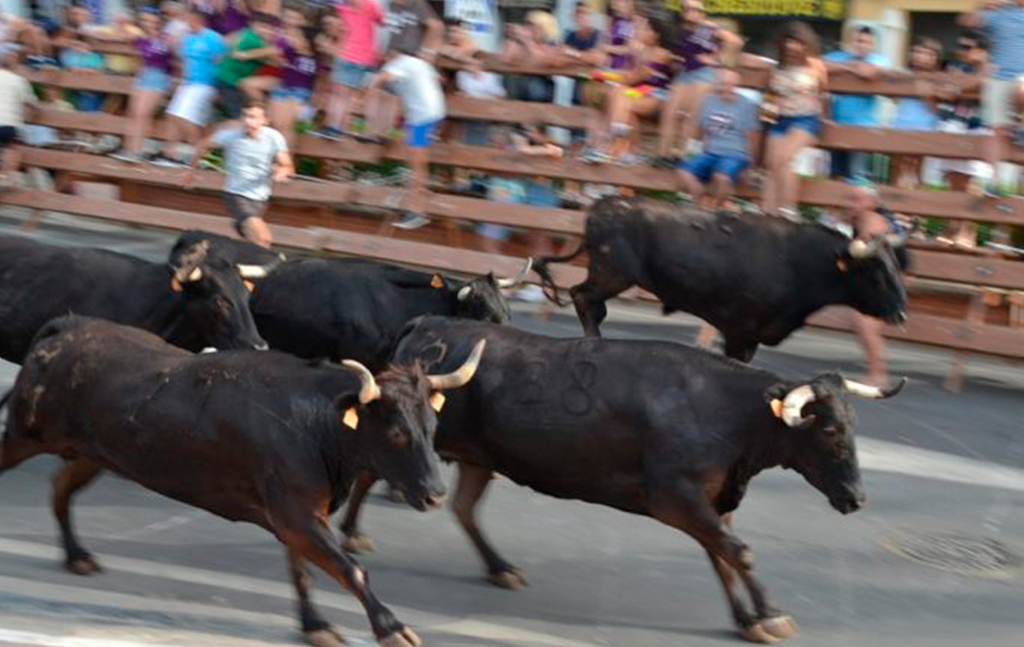
Bull runs, or "encierros", remain a tradition in practically the whole country and are common at patron saint festivals in most regions. They involve a group of people running ahead of a herd of 6 to 10 bulls, cows, young bulls or heifers. In principle, touching the animals is not allowed; they are driven — sometimes led by a lead ox — through the streets of the town along a route that ends at the bullring. The route is normally protected on both sides by fencing known as "talanqueras", which stop the animals from straying.
There is also a variant known as "encierros camperos", whose route takes place wholly or partly outside the urban area, and which involve riders who chase the bulls on horseback through the countryside.
Bull runs can also be held individually, with the aim of allowing participants to test and show off each animal separately.
The problem
Although the festivities committee is responsible for guaranteeing safety, it is difficult to control participation in bull runs, which take place on public roads during patron saint festivities. Every year, accidents caused by overconfident, inexperienced or drunk runners are reported, and it is common for minors to take part. Depending on the autonomous community, the minimum age allowed varies between 14 and 18.
For the bulls or heifers, running through paved streets surrounded by noise, music and stimuli is already harmful in itself. The herd generally stays together and tries to complete the route as quickly as possible in order to return to the pens, but it is common to see animals left behind, disoriented, or distracted by participants who taunt and harass them.
In individual runs, animals are separated from the herd and forced to face the danger alone, which causes them even greater anguish and confusion.
Bull runs are usually held every day during the patron saint festivities. These bulls may be used in different towns, especially in small towns with little bullfighting programming, or they may be the same six animals that will be fought and killed that same afternoon in the bullring.
Sometimes the public throws heavy objects that hit the animal's back or head. The aim is to provoke them into moving and to add excitement to the event.
Reasons
Bull runs may appear to be one of the least harmful forms of bullfighting for the bulls, since they are perceived as less violent, with no direct contact with the animal. In theory, touching or injuring it is not allowed. However harmless they may seem, these are large, powerful animals running through a crowd that does not always keep a safe distance from the herd. Falls, bruising and goring injuries are common.
This tradition dates back to times when herdsmen would drive cattle on foot from the outskirts, or from the farms, into the town centre. Whenever there was a bullfighting event, the whole town would come out into the streets to admire the animals that would later be fought in the ring.
Consequences
- Falls and injuries: City pavement is no place for bulls' legs. Bends, changes in level and slippery surfaces can cause falls and injuries ranging from sprains to serious wounds that can lead to death. As in the recent case in Ontinyent (Valencia), where a bull picked up speed on a straight stretch and plunged off a bridge. It broke its legs in the fall and had to be put down due to the severity of its injuries.
- Heatstroke: Patron saint festivities in most Spanish towns take place during the summer months, when temperatures tend to be very high. Bulls are forced to run under the scorching sun, tiring quickly and risking heatstroke.
- Exhaustion: Bovines in general are calm, ruminant animals that spend half their lives grazing and the other half resting. They are not built to run long distances over a prolonged period, least of all the adult animals chosen for this type of event, which are much heavier and clumsier.
- Cardiac arrest: Exhaustion, the heat, and the enormous stress caused by exertion and the harassment of the crowd can push animals to their limits. Every year, new cases are reported of bulls collapsing after suffering a heart attack.